NDA is a premium banking service offering personal support and benefits for comfortable living and travel.
The brief
Develop a brand-building out-of-home concept for airport boarding bridges, readable at close range and with strong potential for organic sharing.
01 /
Communication constraints
What connects very different people when they travel across Russia?
01
2–3 seconds to connect
Passengers move with the crowd, their attention constantly shifting: checking boarding passes and seat numbers, rearranging hand luggage and greeting cabin crew at the aircraft door.
02
A close-up, fragmented encounter
The wall is less than half a metre away. Wide visuals that need to be seen as a whole do not work.
03
Every fragment works independently, in both directions
No storylines running from A to B. The message must be clear from a single panel, even a photo of a tiny fragment. Complex metaphorical narratives will not work.
04
Nothing that stops the flow
A second for a photo that will not simply stay in the camera roll, but be shared and spread.
05
Only walls and adhesive film
Create a wow effect within these limits, keeping execution and budget minimal.
We have just 2 secondsto catch the eye and stay in the memory.
We will not look for the insight within premium banking. Our audience extends beyond the category, so the entry point is not bank positioning or products, but universal feelings and familiar human patterns.
There is no time on a boarding bridge to explain banking benefits: passengers are boarding, close to the wall and seeing only fragments. Each idea therefore needs a human situation that makes sense without backstory. Meeting loved ones, texting mum or remembering a first flight creates recognition, connecting the brand with care for what already matters.
02 /
Concepts
01 /
Screens of Memories
Insight
I don’t know how many kilometres separate me from my hometown or the place I long to return to. But I know exactly how many hours it takes to fly there. For me, the distance to places close to my heart is travel time, not a number on a map.
Idea
Rethink the map of Russia: replace kilometres with a metaphorical measure of the hours between us, our hometowns and loved ones.
Execution
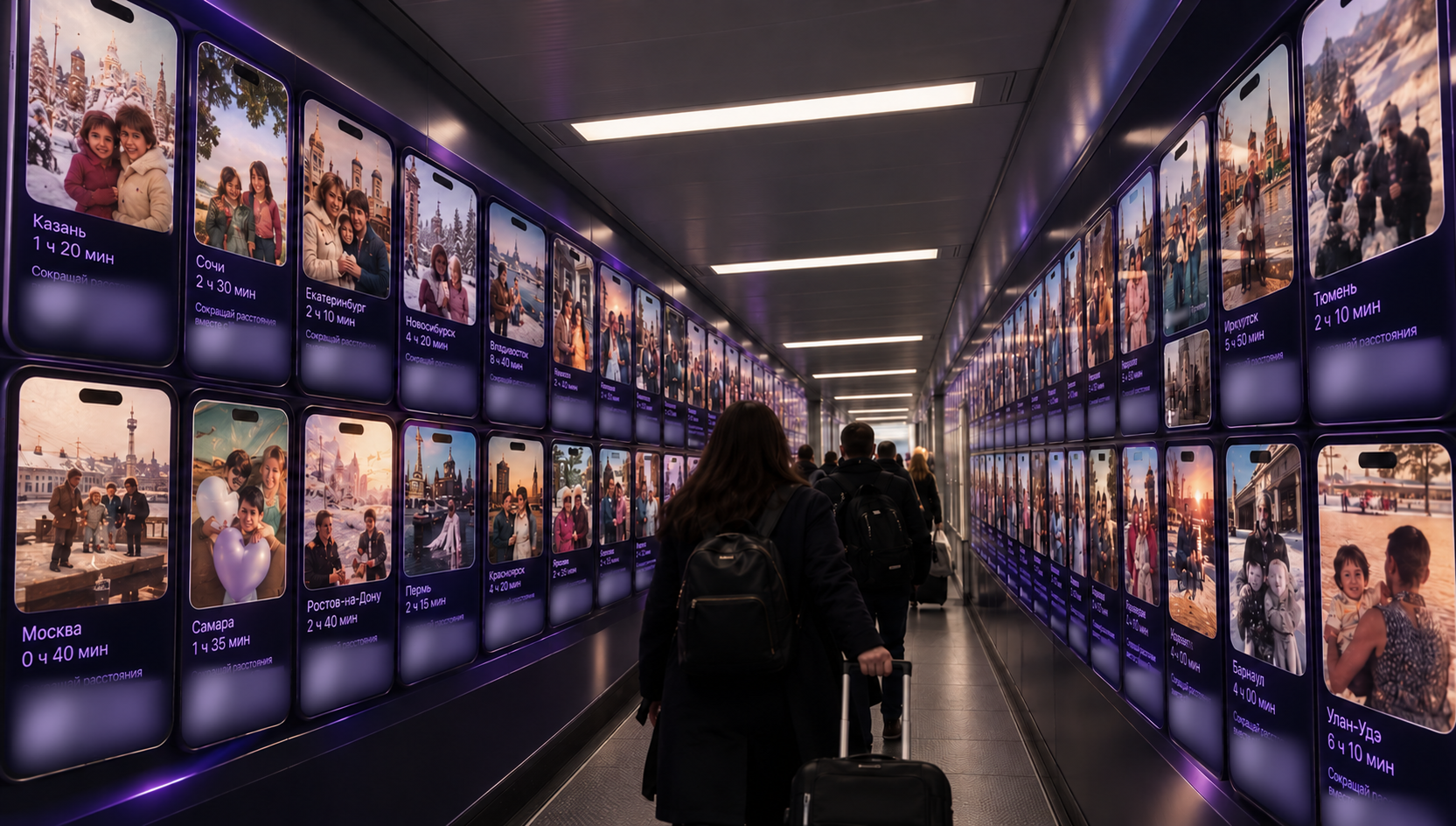
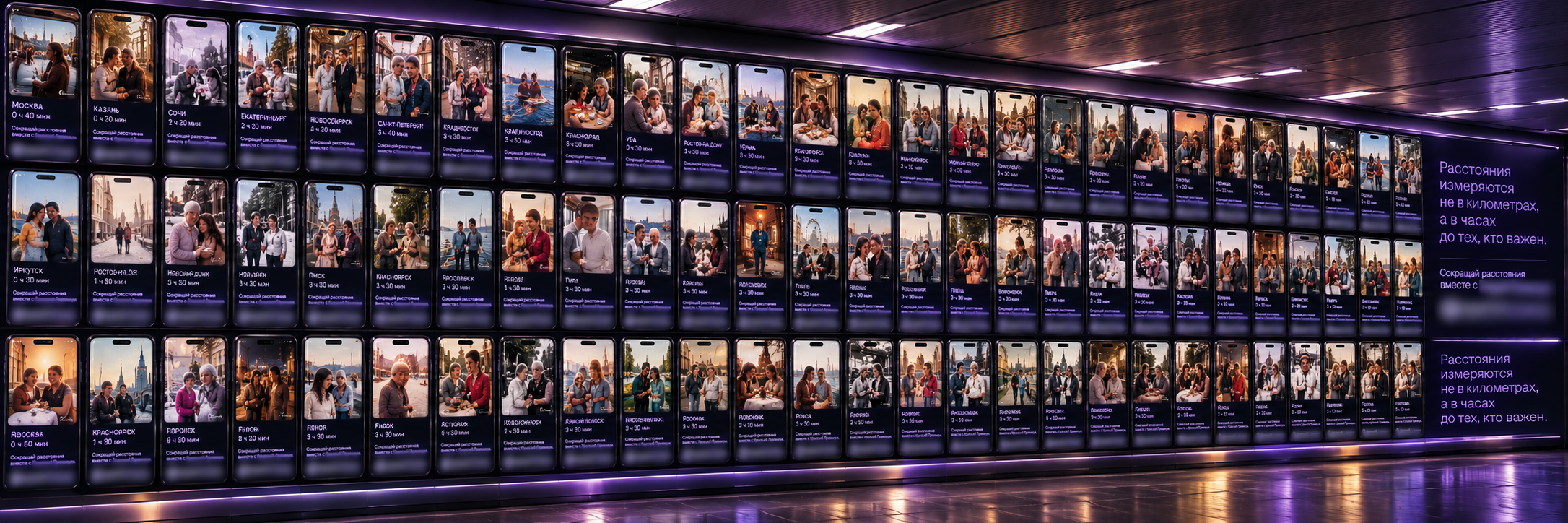
The whole wall becomes a mosaic of differently sized screens. Each holds a warm image of someone in their city: with family or friends, on a familiar street or in a courtyard. Once ordinary moments have become memories of home. The proposed execution draws on Russian internet archives. A discreet line beneath each image expresses time to the people who matter. Individual screen sizes allow a passenger to see and photograph one frame up close without reading the whole wall.
Why it works on a boarding bridge
A warm personal image and the time until a reunion make sense on their own. Even one fragment can remind a passenger of their own story. The idea needs no sequential reading of the mosaic.
«Distance is measured not in kilometres, but in hours to the people who matter. Bring them closer with NDA.»
Reading the visual
Personal images and short reunion-time captions form the mosaic. Screens repeat along both walls of the boarding bridge; one nearby fragment is enough for a passenger to recognise their own story.
The full wall shows the mosaic’s rhythm: many self-contained frames create a shared space of memories. Its meaning is independent of the direction in which passengers enter.
02 /
How Far to Your People?
Insight
I’m not just flying to another city: I’m flying to my mum, going fishing with grandad or meeting friends. My ticket names a place, but what matters is who is waiting there. I want to be with them, not just reach a point on a map.
Idea
Turn the boarding bridge walls into a distance board. Replace city names with familiar situations: “Home to Mum”, “To Grandma’s Country House”, “Camping with Friends”. Each passenger supplies their own route and associations.
Execution
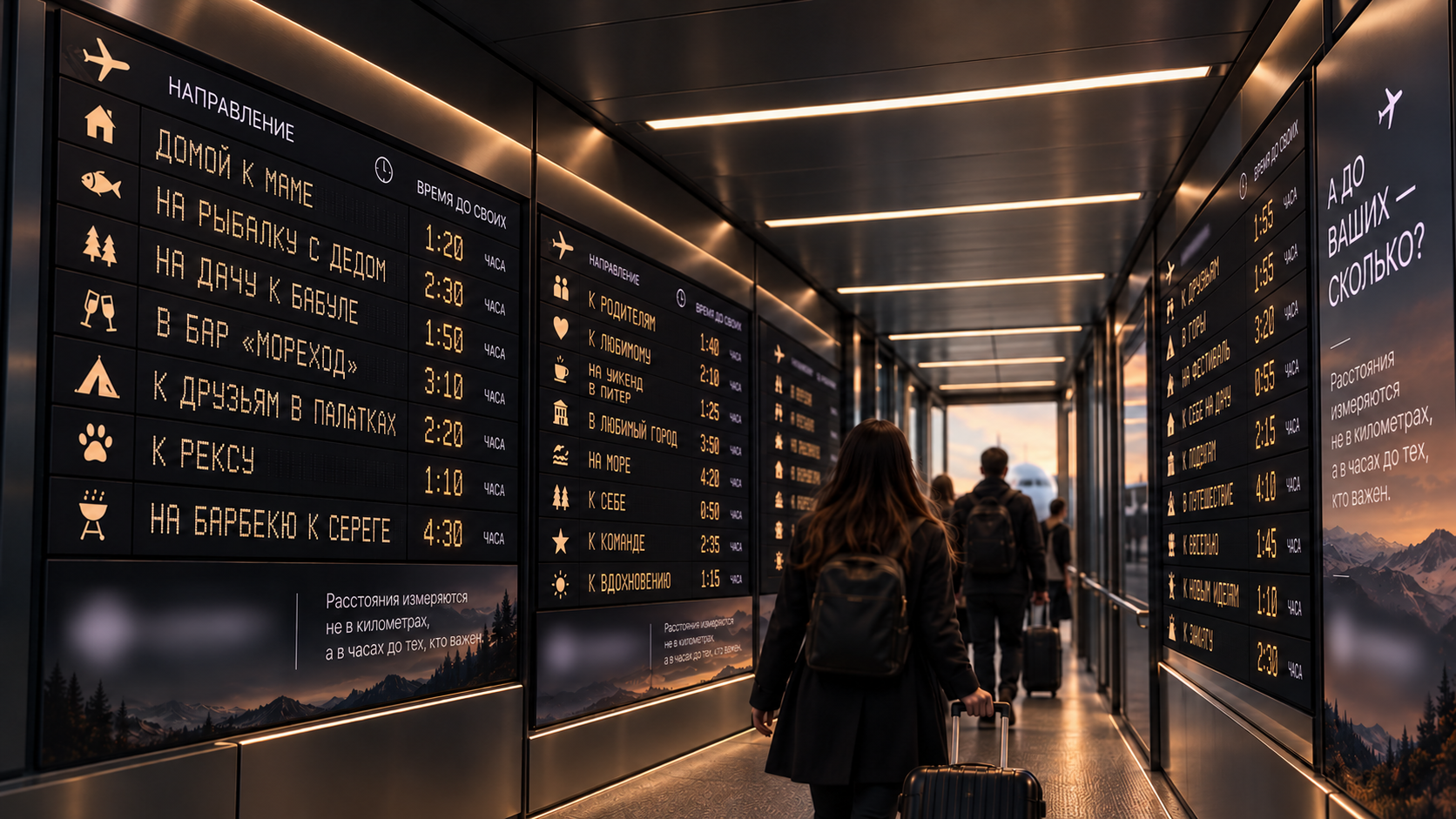
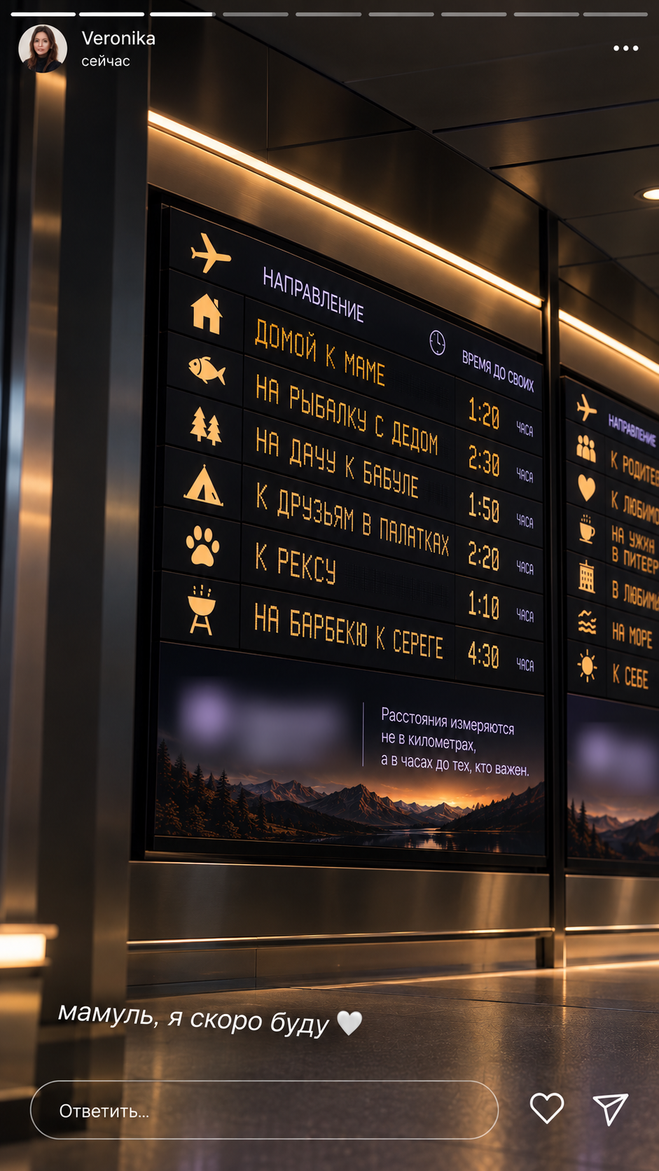
Use departure-board styling: dark backgrounds, large lettering and hours, with purple accents. Replace city names with “Home to Mum”, “Fishing with Grandad”, “Camping with Friends” and other personal reasons to fly. Show the time until the reunion beside them. Repeat “How far to your people?” between blocks, inviting passengers to supply their own answer.
Why it works on a boarding bridge
The familiar departure-board format is instantly readable, while the unexpected destination sparks a personal association. Each line stands alone, understood on the move or captured in a photo of a small fragment.
«How far to your people?»
Reading the visual
The wide view shows boards running along both walls. Large lines work individually; the repeated question shifts attention from an abstract destination to a personal journey.
How the idea can become personal content
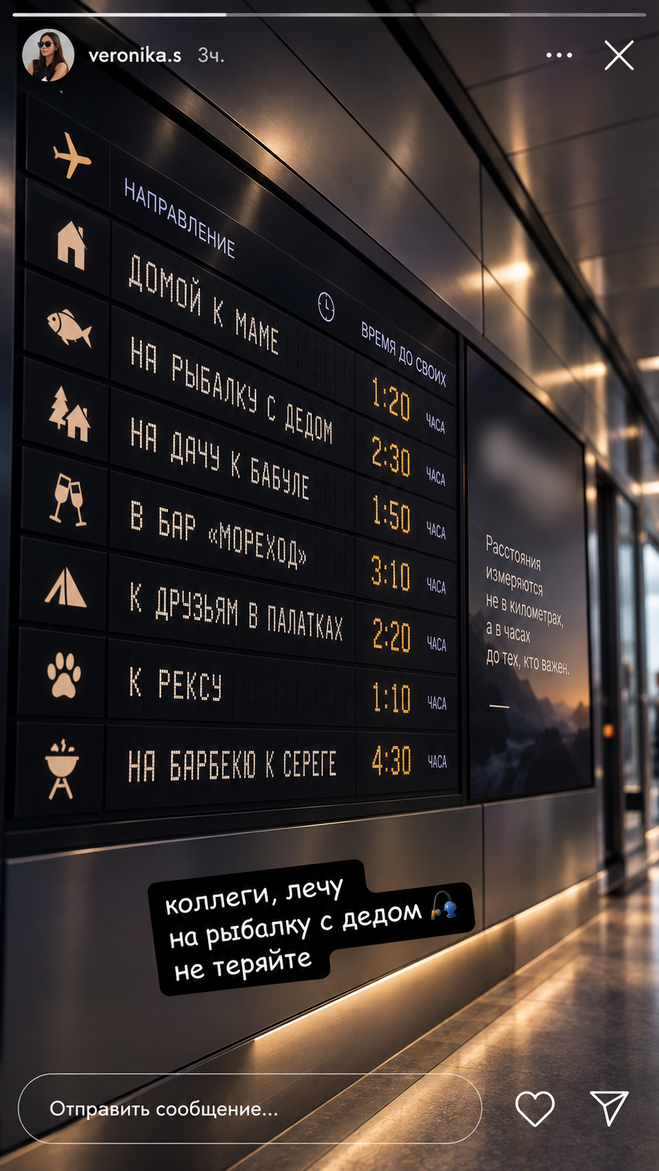
Concept Stories show how a passenger might select a board fragment and add their own story. They illustrate the activation, rather than document a delivered campaign.
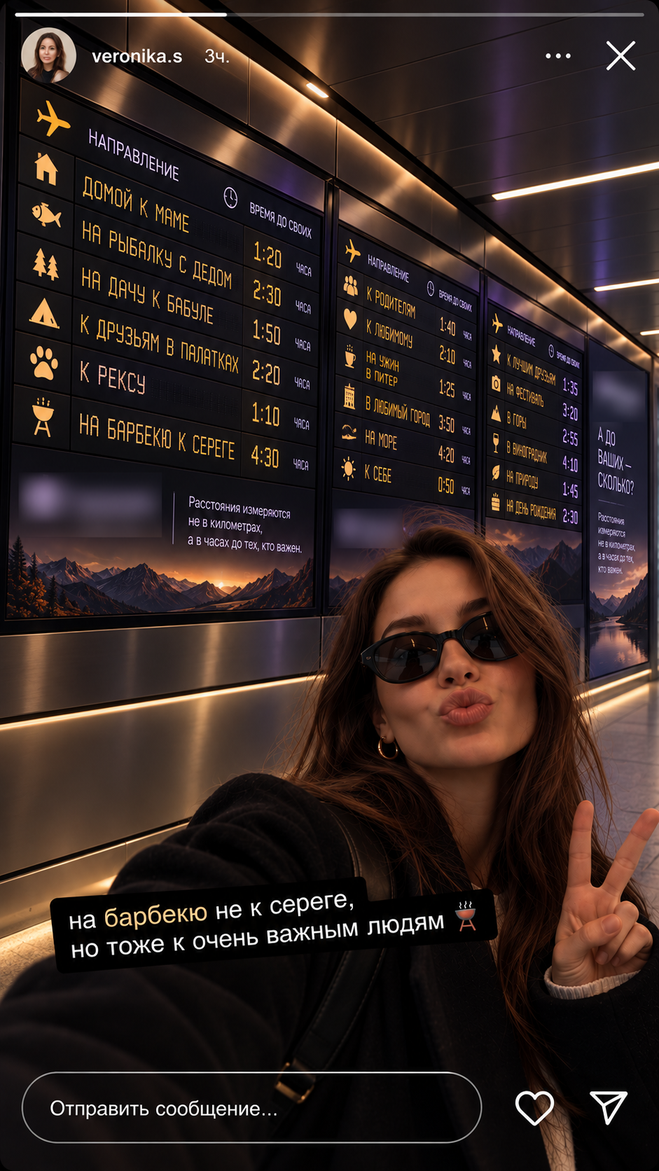
A close-up of the board prompts a personal travel caption. Here, the passenger chooses “Fishing with Grandad” and adds their own story to the advertising message.
A selfie brings the person and recognisable board lines into one frame. A small section of wall is enough to communicate the idea.
“Home to Mum” gains a personal continuation in the passenger’s caption. The advertising question can become a message to loved ones.
03 /
Text Your Mum
Insight
I’ve been an adult for years and I’m used to taking care of everything myself. But my mum still worries about every flight, and in the rush I sometimes forget to text.
Idea
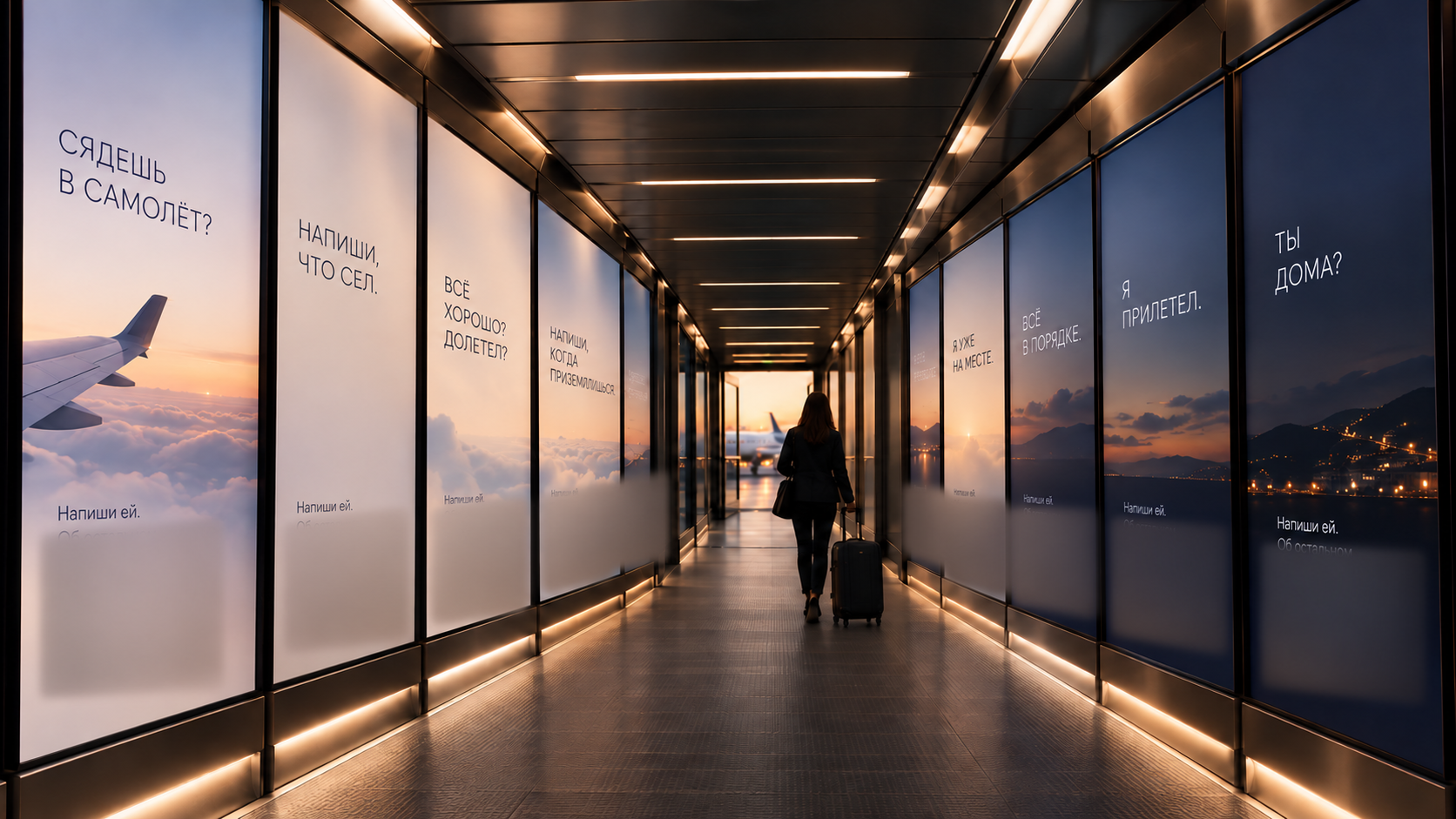
Remind passengers of one simple action: text mum after landing. Put short, familiar messages on the walls: “Are you on the plane?”, “All okay? Have you landed?”, “Are you home?”.
Execution
Replace a long advertising story with familiar lines on large vertical panels. Views through aircraft windows establish the flight context, while brief questions sound like messages from someone close. The closing line connects texting mum with NDA’s promise of care.
Why it works on a boarding bridge
One short message is recognisable without explanation or reading the whole wall. It carries both emotion and a clear action. The brand expresses care through a familiar human gesture, not a list of banking advantages.
«Your mum doesn’t care which class you fly. What matters is that you’ve landed. Text her. NDA will take care of the rest.»
Reading the visual
Light and dark panels alternate, but every line stands alone: “Are you on the plane?”, “Are you home?”. Passengers need not read them in order. Flight imagery and a familiar tone make the situation recognisable within a brief encounter.
04 /
A Hello from Childhood
Observation
Childhood travel memories are not only about the trip or destination. The journey itself is a collection of sensations: waiting by the window, a drink’s taste, a favourite toy nearby. Flying becomes routine as an adult, yet these details still bring back personal experiences.
Insight
I’m used to treating a flight as a journey to get over with. As a child, even a window seat and a juice on board felt like an adventure. I want that anticipation back — to notice the journey, not just wait to arrive.
Idea
Take passengers back in time through large images of childhood flying. Each wall fragment presents a familiar moment and invites them to relive it.
Execution
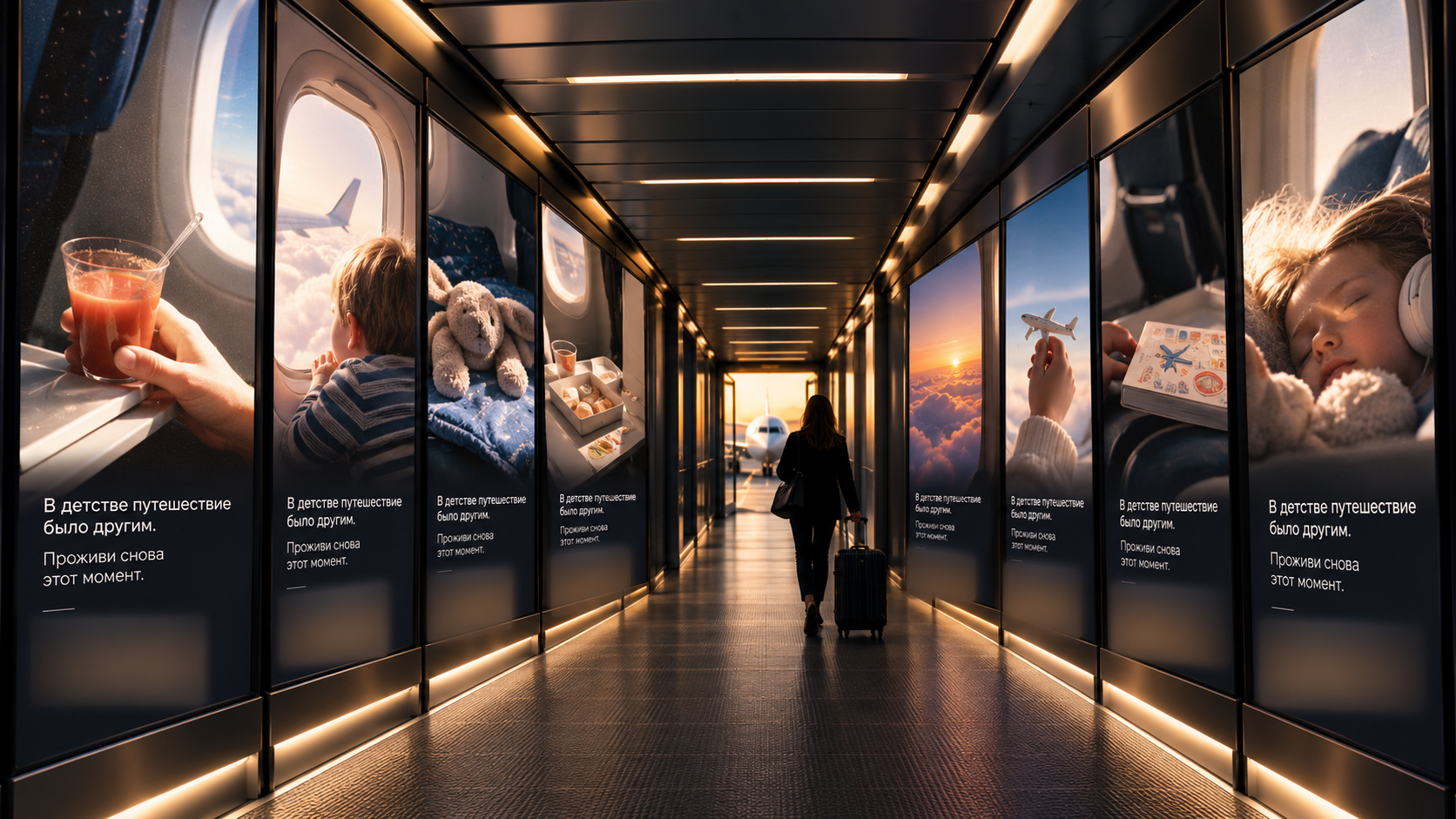
Use separate large panels for recognisable details: tomato juice by a window, a child looking outside, a toy on the journey, an airline meal. No sequential storyline: each moment should independently evoke childhood travel. A shared message connects the panels and ends with NDA’s promise of care.
Why it works on a boarding bridge
The whole composition is not needed for recognition: one object or scene triggers an association. This fits the close-up, fragmented encounter on a boarding bridge and lets each passenger remember their own story.
«Travel felt different as a child. Relive that moment. NDA will take care of the rest.»
Reading the visual
Each panel brings one detail close: a glass of juice, a window view or a toy. The scale is designed for close-range viewing — passengers notice one image rather than try to see the entire wall. Repeated text connects different memories into one communication.